Mobile, Alabama sits in one of the wettest corners of the country. Average annual rainfall tops 65 inches, the live oaks never fully dry out, and humidity hangs in the air from March straight through October. That combination does one predictable thing to house siding: it grows stuff. Black and green streaks of mildew, algae, and gloeocapsa magma bacteria creep across vinyl, brick, Hardie board, and stucco alike. By the time most homeowners in Midtown Mobile (36606) or Spring Hill (36608) notice it, the growth has been there for at least a season.
At Baldwin Preaux Wash we use soft washing rather than high-pressure blasting to clean house exteriors throughout Mobile. The difference matters. Soft washing applies a low-pressure, biodegradable cleaning solution that kills the biological growth at the root level. High-pressure washing can force water behind J-channel on vinyl siding, lift shingles on overhanging eaves, and strip paint on older wood trim. The Oak Park bungalows, the older two-stories in Oakleigh Garden Historic District, and the brick colonials off Dauphin Street in West Mobile all have details that do not handle a pressure gun well. Soft washing handles them fine.
Why Mobile Homes Get Dirtier Faster Than You Expect
Three things work against you in Mobile. First, the canopy. Midtown and the Spring Hill corridor are shaded by a near-continuous canopy of live oaks and magnolias. That shade keeps siding wet longer after every rainstorm, giving mildew spores the damp surface they need to take hold. Second, the pollen. Mobile ranks among the highest pollen-load cities in the country. Pollen settling on damp siding mixes with organic debris and gives algae something to eat. Third, the proximity to Mobile Bay. Even for homes a few miles inland around the Airport Boulevard corridor (36606) or up toward Tillman's Corner (36619), prevailing southerly winds carry enough salt-laden moisture to accelerate mildew growth on north-facing and shaded walls.
Which Siding Types Are Most Common in Mobile and How We Treat Each One
Vinyl Siding
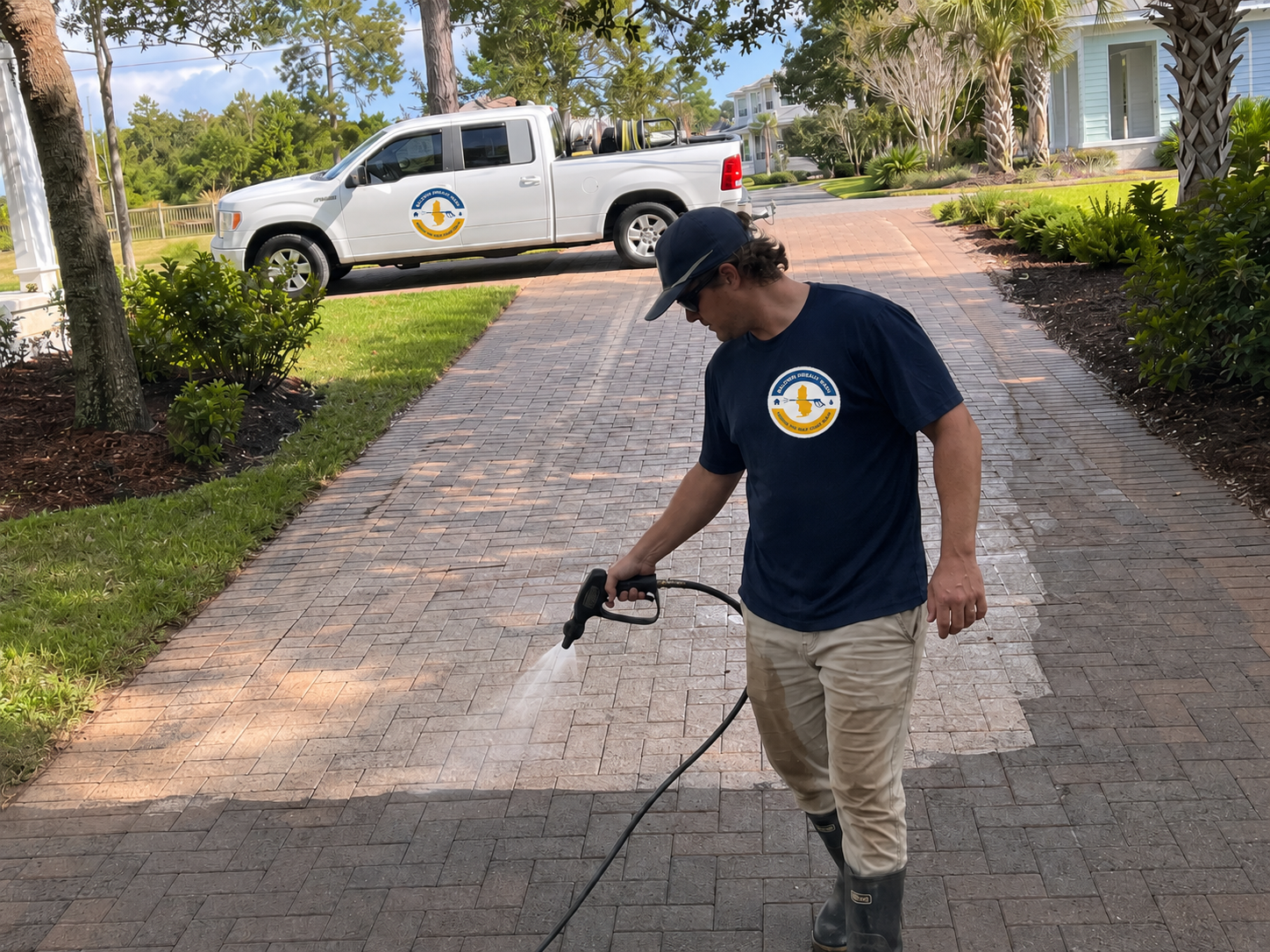
Most post-1990 construction in west and south Mobile uses vinyl. Vinyl is durable but it holds moisture in the overlapping channels, and that's where mildew colonies start. Soft washing at 100 to 200 PSI with a surfactant-based mix removes the growth without flexing or cracking the panels. We rinse from the top down so runoff doesn't re-contaminate lower courses.
Brick and Mortar
A lot of Spring Hill and the older neighborhoods near USA South are brick. Brick is porous, and it picks up efflorescence, algae, and mildew staining. High pressure blows mortar out of older joints. Our soft wash approach uses a diluted sodium hypochlorite solution that kills the biological growth, followed by a controlled low-pressure rinse. We adjust dwell time and concentration based on how porous the brick looks. Homes near the Spring Hill College campus built in the 1950s and 1960s often need a longer dwell time than newer construction.
Hardie Board (Fiber Cement)
Hardie is popular in newer subdivisions around west Mobile and the Cottage Hill Road corridor. It paints well and holds up in humidity, but the factory primer can absorb mildew staining faster than people expect in the first few years after installation. Soft washing removes the staining without lifting paint or abrading the surface texture. We follow James Hardie's own cleaning guidelines, which call for low-pressure application.
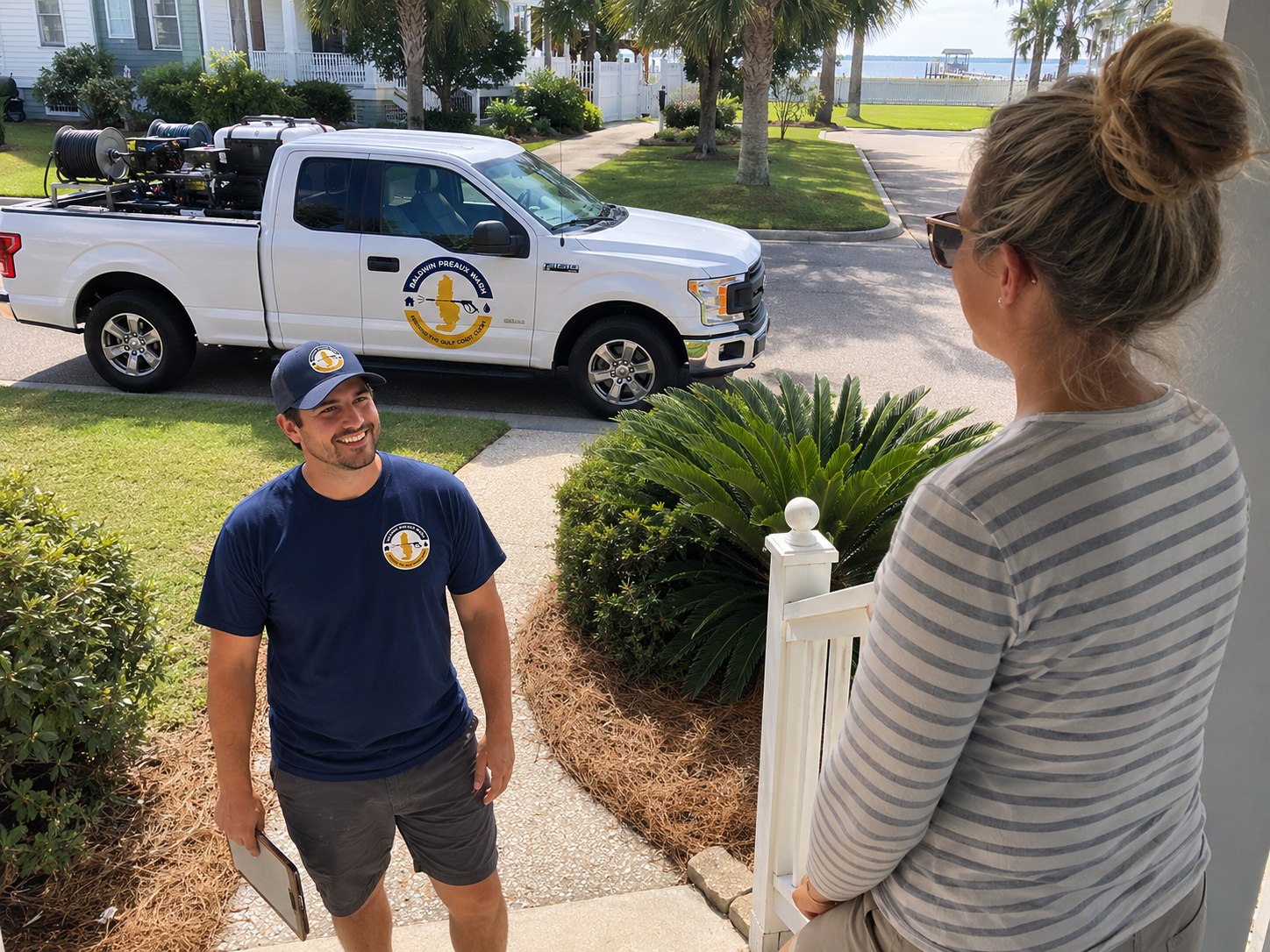
We serve Midtown, Spring Hill, Tillman's Corner, and neighborhoods throughout Mobile County. Most houses are quoted within 24 hours.
Neighborhoods and Zip Codes We Serve Regularly in Mobile
Baldwin Preaux Wash runs crews through Mobile multiple times a week. We are not a company that treats Mobile as an afterthought to the Eastern Shore work. Here are the specific areas we cover most often:
- Midtown Mobile (36606) - older housing stock, lots of tree canopy, brick and wood siding prevalent
- Spring Hill (36608) - mix of brick colonials and newer vinyl; Spring Hill College area homes included
- West Mobile / Cottage Hill (36609) - post-1980 vinyl-sided neighborhoods, heavy pollen load
- Tillman's Corner and Westwood (36619) - newer construction, subdivision HOA cleanups common
- Oakleigh Garden Historic District (36604) - older bungalows and Craftsmans requiring gentle soft wash technique
- Airport Boulevard corridor (36606) - commercial-adjacent residential, high traffic dust on siding
- Saraland and Satsuma (36571, 36572) - just north of the city, pine tree pollen and shade mildew
What the Soft Wash Process Looks Like on the Day of Service
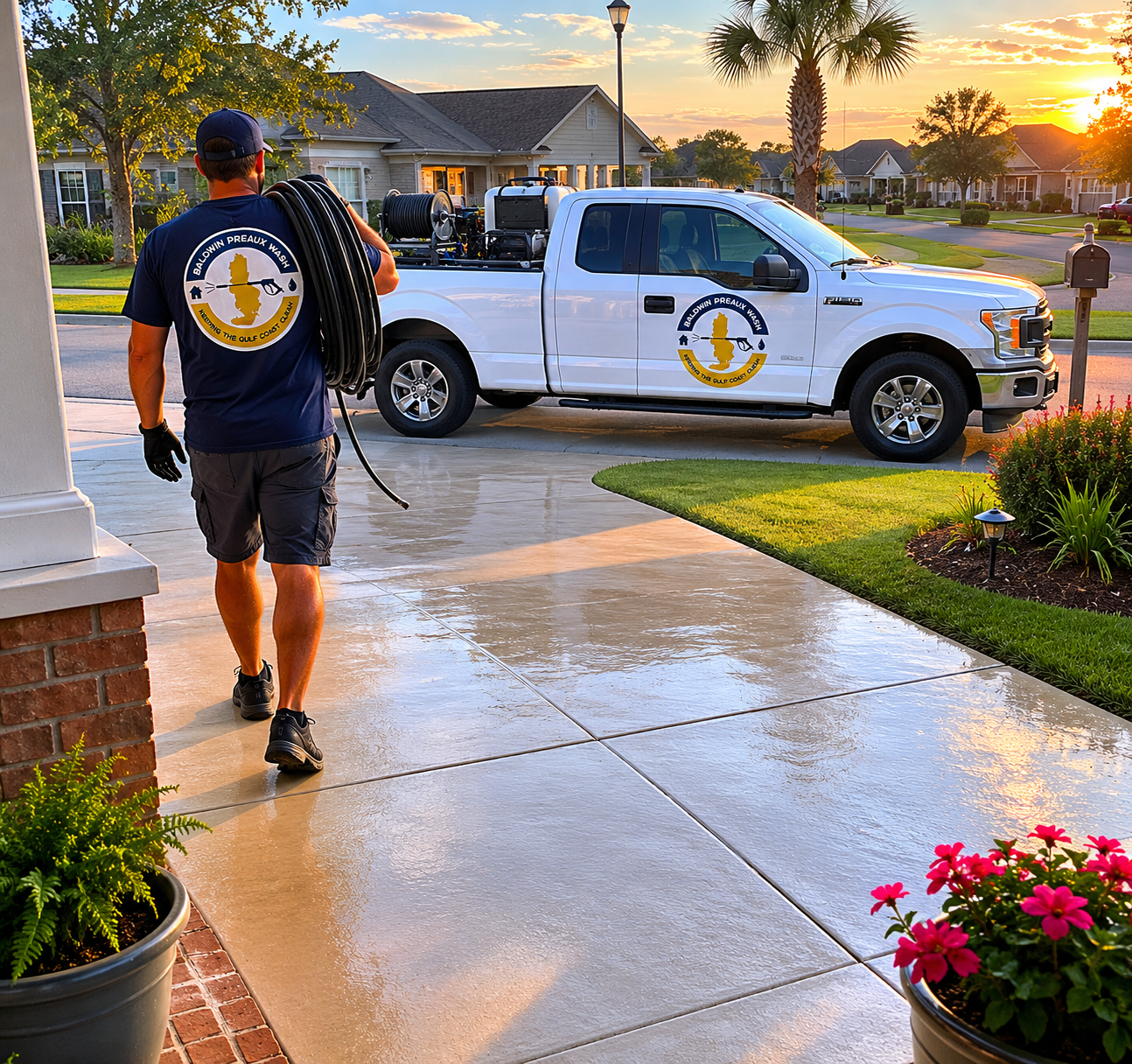
When a Baldwin Preaux Wash crew pulls up to your Mobile home, the first thing they do is a walk-around with you or whoever is on-site. We are looking for open windows, potted plants, exterior light fixtures with exposed sockets, and any painted wood trim that needs masking or extra care. Landscaping beds near the foundation get a pre-wet with plain water before solution is applied, and they get a thorough rinse after. We do not skip that step.
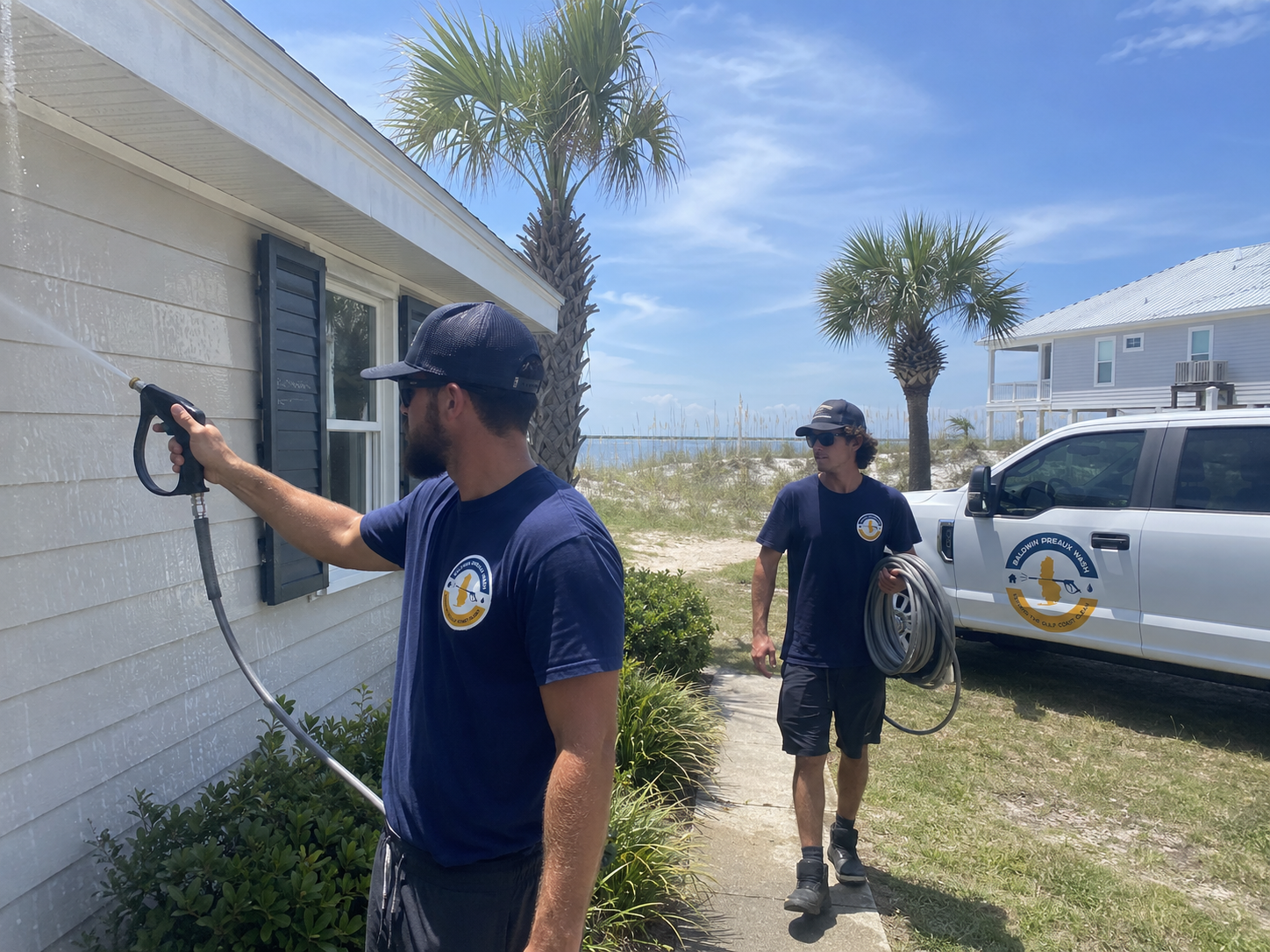
Application starts at the roofline and works down. The cleaning solution is allowed to dwell on the surface long enough to kill biological growth completely - rushing that step leaves staining behind within a few weeks when the dead but unrinsed growth turns brown. After the dwell period we rinse with low pressure from the top down. Gutters get a quick wipe-down of the face during the rinse pass, which removes the tiger-stripe oxidation staining that runs down the front of aluminum gutters over time. The whole job on an average-size Mobile home runs two to four hours depending on the amount of shaded siding and any heavily soiled areas.
How Often Should You Wash Your Mobile Home's Exterior?
For most Mobile homes, once a year is the right interval. If you are in a heavily shaded lot in Midtown or right on a wooded lot off Dauphin Island Parkway, you may see mildew return faster and benefit from a wash every 9 to 10 months. Homes with less shade and good southern exposure in newer parts of west Mobile or Tillman's Corner can often go 12 to 18 months. The honest answer is: when you see streaking starting to form, do not wait another season. The longer biological growth sits on a painted or finished surface, the more stubborn the staining and the higher the chance of permanent discoloration on lighter-colored siding.
Signs It Is Time to Call
- Black vertical streaks running down siding from the soffit line
- Green or gray patches on north-facing walls or under eave overhangs
- Dark spotting between brick courses or on painted wood trim
- Siding that looks dull or gray even though it is supposed to be white or beige
- Visible algae on the lower courses near the foundation or behind downspouts
- A musty smell near the crawlspace vents after rain
Call or text (251) 978-5503. We'll give you a straight quote - no surprise fees, no hard sell.
Pricing and What Affects the Cost of a House Wash in Mobile
We price house washing in Mobile by the square footage of the home's exterior wall surface, adjusted for a few factors: single-story versus two-story access, the degree of mildew buildup, siding material, and whether there are add-on services like gutter face brightening or concrete cleaning at the same visit. Most single-story homes in the 36606, 36608, and 36609 zip codes run in a range that is straightforward to quote from a few photos and the address. We do not charge a separate travel fee for Mobile jobs. Give us a call at (251) 978-5503 or send photos through our website and we will have a number back to you the same day in most cases.
Serving Mobile, Midtown, Spring Hill, Tillman's Corner, Saraland, and surrounding areas. Free quotes, no obligation.
Frequently Asked Questions
Is soft washing safe for older homes in Midtown Mobile or the Oakleigh Historic District?
Yes. Soft washing is actually the preferred method for older homes because it uses low pressure that will not damage original wood trim, aged mortar joints, or delicate painted surfaces. The cleaning solution does the work, not water force. We adjust the chemical concentration and dwell time based on the surface and its condition.
Will the cleaning solution harm my landscaping or Mobile Bay area plants?
We pre-wet all landscaping beds and shrubs near the house before applying any solution, and we rinse them thoroughly after. The diluted sodium hypochlorite we use breaks down quickly once it contacts soil and organic matter. In more than a decade of work in the Mobile and Baldwin County area, we have not had documented plant damage from a properly performed soft wash.
How long does a house washing last in Mobile's climate?
Most homes in Mobile stay clean for 12 to 18 months. Homes with heavy shade from oaks or magnolias may see mildew return a bit sooner, closer to 9 to 12 months. Good southern exposure and open airflow extend the results. We can walk through your specific situation when we do the quote.
Do you wash two-story homes in Spring Hill and west Mobile?
Yes. Two-story homes are routine for us. We use extension wands and soft-wash systems designed to reach second-floor siding and gable ends safely from the ground, which means no ladders leaning against your gutters. The price is a bit higher than a single-story due to wall surface area, but the process is the same.
Can you combine house washing with driveway cleaning or gutter work on the same visit?
Absolutely. Many Mobile homeowners combine house soft washing with concrete driveway cleaning and gutter face brightening in a single visit. It's more efficient and we offer bundled pricing. Just let us know what you're interested in when you call (251) 978-5503 or request a quote.
Do you serve Saraland, Satsuma, and other areas just north of Mobile city limits?
Yes. Saraland (36571) and Satsuma (36572) are part of our regular Mobile-area service rotation. The same pine tree pollen and shade-driven mildew conditions that affect Midtown and Spring Hill are common in both communities. Call us at (251) 978-5503 to schedule.